CHAPTER 18 OF 54 · SHAPE THE SOUND
Phase
Phase is INK's phase distortion generator, after the Casio CZ synths. A cosine is read through a bent phase: with no bend it plays a sine, and more bend adds harmonics, so the bend amount, DCW, sweeps the tone as a low-pass cutoff does.
Each voice has two of these oscillators, A and B, each playing in both stereo channels. They share the wave and DCW. The PHASE section sets B's level, interval and detune, and whether A and B are mixed or multiplied (ring modulation).
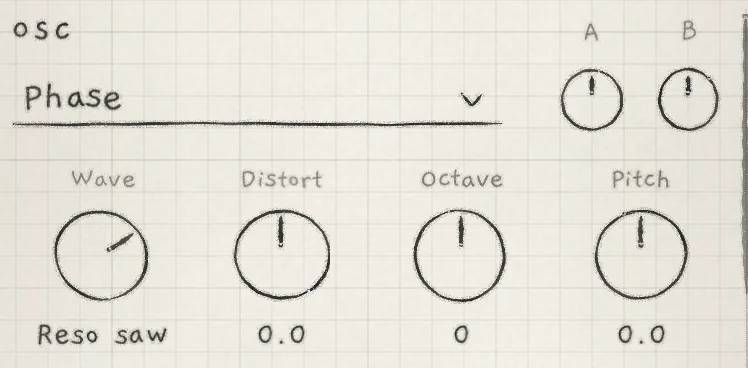 123
- 1Generator box
- 2Wave
- 3Macro A and B
#Choose Phase
On the Sound tab, choose Phase in the generator box at the top of OSC. In the Library, the Engine filter lists Phase as well. The small A and B knobs beside the generator box are Macro A and Macro B (Macros and dice), not oscillators A and B.
Everything after the oscillators works as on the other generators: the rest of OSC, the low-pass gate, the Sub, the filter, both envelopes and the effects (Oscillators, Sub oscillator).
The PHASE values are saved with the sound. They stay in the sound when you switch to another generator and return when you switch back. Sounds made before the Phase generator load with the PHASE Init values in the card below.
#Wave
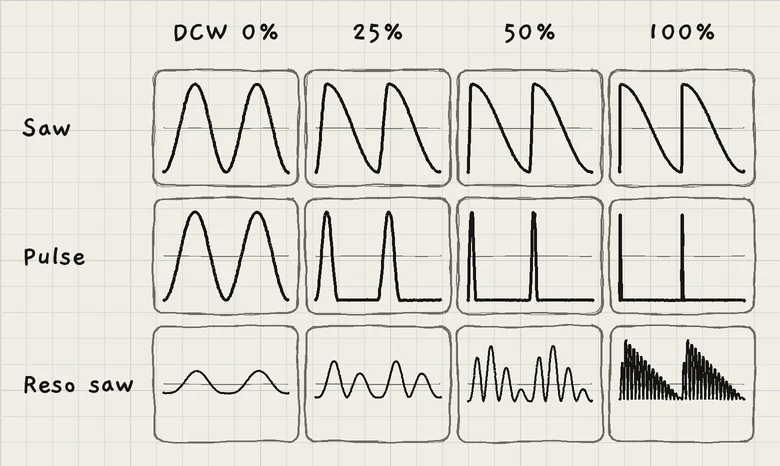
Wave is the tone control of OSC on Phase. It sweeps through the waves below, crossfading between neighbours; the value names the nearest wave. The waves are level-matched to the Saw, so a sweep stays near one loudness. A and B always play the same wave.
| Wave | At DCW 100% | At DCW 0% |
|---|---|---|
| Saw | A sawtooth: a steep edge, then a slow ramp. | Sine |
| Square | A square: a steep edge in each half cycle, flat between. | Sine |
| Pulse | A narrow pulse: one short cosine cycle, then flat. It narrows as DCW rises. | Sine |
| Double sine | Two cosine cycles of unequal length in each period. | Sine an octave up |
| Saw-pulse | A plain rising half, a steep fall, then flat. | Sine |
| Reso saw, Reso round, Reso trap | A resonant peak: a cosine at up to 16 times the note, restarted every cycle under a falling-ramp, rounded or trapezoid window. | One cycle under the window |
In the Matrix, the first OSC row reads Wave on a Phase sound. CC 13. A sound switched to Phase keeps its tone control's value, so Wave lands where Detune, Width or Position was: the Init sound reads Saw-pulse (Tone control).
#PHASE
The PHASE section sits between OSC and SUB on the Sound tab and shows only on the Phase generator.
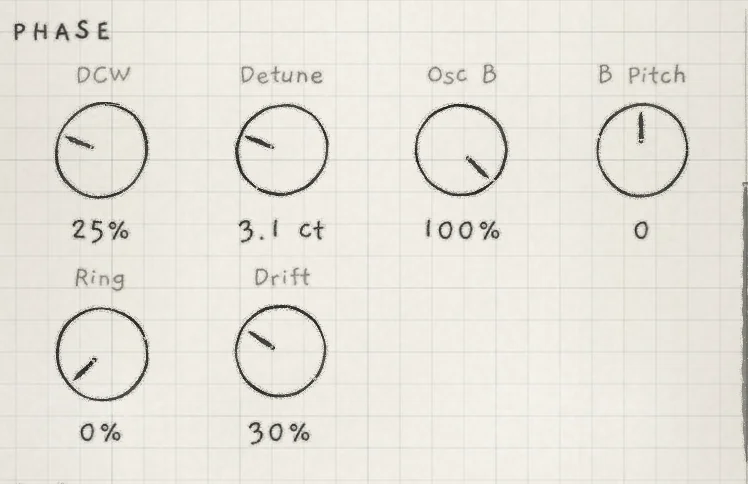 123456
- 1DCW
- 2Detune
- 3Osc B
- 4B Pitch
- 5Ring
- 6Drift
- DCWBend amount of A and B, from a sine to the full wave. 0 to 100%; exponential. Init: 25%, with Prs → DCW, +50.
- DetuneDetunes B against A, in opposite directions in the left and right channels. 0.0 to 50.0 ct; squared curve. Init: 3.1 ct.
- Osc BLevel of B in the mix, and depth of the ring. 0 to 100%. Init: 100%.
- B PitchInterval of B against A. −24 to +24 st in whole semitones; bipolar. Init: 0.
- RingCrossfade from the mix A + B to the ring product A × B. 0 to 100%. Init: 0%.
- DriftSlow random pitch wander of A and B, and a slightly different DCW for each voice. 0 to 100%. Init: 30%.
The PHASE controls have no MIDI CC; play them from a controller through a macro (Play a control without a CC).
#DCW
DCW (the CZ's Digital Controlled Wave) bends the phase at which the cosine is read. At 0% the waves play a sine; raising DCW adds harmonics up to the full wave at 100%. The curve is exponential, so a DCW sweep moves as a cutoff sweep does. On the Reso waves, DCW moves the resonant peak from the note up to its 16th harmonic.
Init sets Prs → DCW, +50: a firmer touch raises the bend and brightens the note. For a CZ-style DCW envelope, route Envelope 2 to DCW in the Matrix (Modulation matrix).
DCW's reach falls with pitch: above a limit set by the note, more DCW adds no harmonics. On the Saw the limit is about 85% at A2, 52% at A4 and 19% at A6. Square and Pulse stop a little lower, and a full ring (Ring and Osc B at 100%) lowers every limit by an octave. B has its own limit, so at B Pitch +12 it stops brightening an octave below A. On the Reso waves, the resonant peak stops rising at about 5.5 kHz. From about F7 up, every wave fades to a sine.
#Osc B and Ring
Osc B sets B's level. At 0% only A sounds, and B Pitch and Ring have no effect.
Ring crossfades the mix A + B to the product A × B. Osc B scales B in both. At Ring 100%, Osc B moves from A alone at 0%, through A amplitude-modulated by B at 50%, to the ring product alone at 100%.
#Detune, B Pitch and Drift
A and B each play in the left and right channels. Detune tunes B up by the shown amount on the left and down by it on the right; A moves a quarter as far the other way. Detune thickens the note and widens the stereo image.
B Pitch sets B's interval in whole semitones. The Sub stays on the played note at every B Pitch.
Drift adds a slow random wander of a few cents to each oscillator. The left and right copies move in opposite directions, so the note's centre stays in tune while the stereo image moves. Drift also gives each voice its own DCW offset, up to ±3% at 100%, so the voices of a chord differ slightly in brightness.
#Matrix
The Matrix has a PHASE group with one row per control: DCW, Detune, Osc B, B Pitch, Ring and Drift (Modulation matrix). The rows are listed on every generator and act only on Phase. B Pitch moves in whole semitones under modulation. Wave is modulated through the first OSC row.
The dice never writes cells in the PHASE rows; it can write the tone control's row, and so modulate Wave (Macros and dice).
- Load Init from the Library and choose Phase in the generator box.
- Set B Pitch to +7.
- Turn Ring to 100%.
- Lower Osc B to 50%.
- Play with light, then firm pressure. A is amplitude-modulated by B a fifth above, and Prs → DCW, +50 brightens both oscillators as you press.