CHAPTER 23 OF 54 · SHAPE THE SOUND
Delay
Each engine has one stereo delay, fed by a send. Its type sets the character of the echoes: Classic is a stereo tape-style echo, Reverse plays each echo backwards, Octave raises every repeat an octave, and Ping-Pong bounces the echoes between left and right. DELAY is on the Sound tab of every generator.
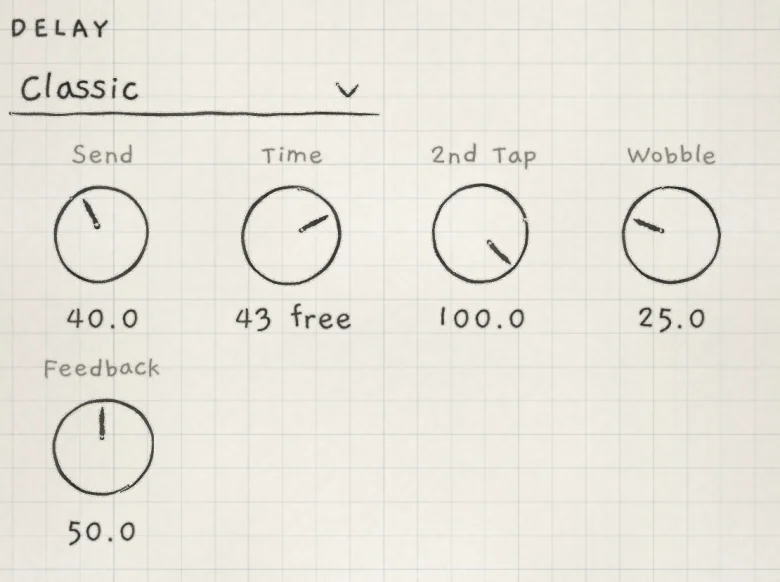 123456
- 1Type menu
- 2Send
- 3Time
- 42nd Tap
- 5Wobble
- 6Feedback
#Type
The menu at the top of the section chooses the type. All types share one set of controls. A type greys the controls it does not use; they keep their values for when you switch back.
| Type | Send | Time | 2nd Tap | Wobble | Feedback |
|---|---|---|---|---|---|
| Classic | live | live | live | live | live |
| Reverse | live | live | grey | grey | live |
| Octave | live | live | live | grey | live |
| Ping-Pong | live | live | live | grey | live |
The type is saved with the sound. It has no Matrix row and no CC, so no source, macro or dice roll changes it.
#Controls
- SendLevel of the engine's signal into the delay. 0.0 to 100.0. Init: 0.0. CC 94.
- TimeDelay time, bipolar: left of centre synced, 1 /32 sync to 32 /32 sync; right of centre free, 0 free to 100 free (about 4 ms to 2.09 s). Init: 43 free (about 400 ms). CC 12.
- 2nd TapTime of the right side as a share of Time. 0.0 to 100.0; at 100.0 both sides are equal. Init: 100.0. Matrix: 2nd tap. CC 112.
- WobbleRandom drift of the delay time, as on tape. Classic only. 0.0 to 100.0. Init: 25.0. CC 113.
- FeedbackLevel of the echoes fed back into the delay: how long the repeats last. 0.0 to 100.0. Init: 50.0. CC 95.
Send sets only the input. Lowering it stops new signal entering; echoes already in the delay ring out at the Feedback setting. The send takes the engine's signal after the engine strip's Level and Mute, so muting an engine lets its echoes ring out (The three engines).
The delay's return goes to the engine's wet bus, where Main Wet/Dry balances it against the dry signal (Reverb and mix). The return also feeds the reverb, so the reverb's Send acts on the echoes too.
Every control except the type is a Matrix row in the DELAY group. Like every row at the engine stages, they read the highest Env 2 and the highest pressure of the engine's voices (Modulation matrix). The dice writes cells only on the Send and Feedback rows; a roll clears the other rows' cells as it clears every other (Macros and dice). All values are saved with the sound.
#Time
Time has two halves. Right of centre it sets a free time, shown as "43 free". The steps are finer at short times:
| Display | Time |
|---|---|
| 25 free | about 131 ms |
| 50 free | about 523 ms |
| 75 free | about 1.18 s |
| 100 free | about 2.09 s |
Left of centre it sets a fraction of one bar in 32nd notes, shown as "8 /32 sync". The steps run outwards from the centre:
| Display | Note value |
|---|---|
| 1, 2, 4, 8, 16 /32 sync | 1/32, 1/16, 1/8, 1/4, 1/2 |
| 3, 6, 12, 24 /32 sync | dotted 1/16, dotted 1/8, dotted 1/4, dotted 1/2 |
| 5, 10, 20 /32 sync | 5/32, 5/16, 5/8 |
| 32 /32 sync | one bar |
Synced times follow the engine's tempo: its Tempo on the Arp and Seq tabs (Arp rhythm and tempo), or, with Sync on, the shared clock, which in a host is the host's tempo (Clock and sync). Synced echoes land on the beat.
The halves are the opposite way round from the arp's Division, which is synced right of centre and free left of it (Arp).
#Classic
Classic is the stereo delay of Plinky, the synth INK grew out of (The three engines). It sums the send to mono and plays two echoes from it: the left at Time, the right at Time × 2nd Tap. At 2nd Tap 100.0 the two coincide and the echo is centred. Below 100.0 the right echo comes earlier, and the repeats of the two sides interleave.
Each repeat loses some low end and passes a soft saturator. Near 100.0 Feedback, the repeats stop decaying and the saturator holds their level, so the delay sustains on its own.
Wobble shortens the delay time by a random amount, with a new target a few times a second. At 100.0 the time varies by up to about 33 ms. Every change of Time, by hand, by Wobble or by modulation, glides, so it bends the pitch of the echoes as tape does.
#Reverse
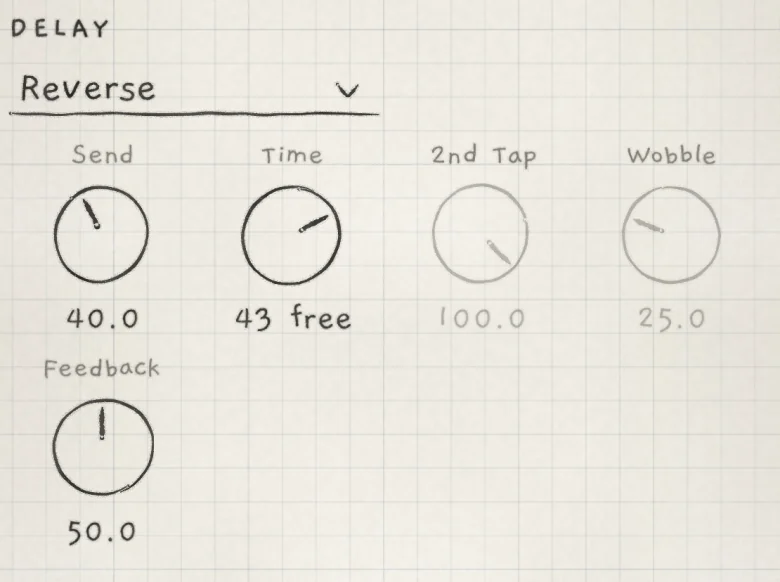 123
- 1Type menu
- 22nd Tap, greyed
- 3Wobble, greyed
Reverse records the input in segments of Time length and plays each one backwards, crossfading between them. A segment lasts at most about 4.2 s; a longer Time is halved until it fits, so 32 /32 sync below about 57 BPM plays half a bar.
Each repeat is filtered and lightly saturated, so the repeats darken as they recirculate. Feedback has no further effect above about 82.0, and the repeats always decay.
#Octave
Octave shifts every pass through the delay up one octave. The first echo is an octave above the played note, the second two octaves above, and so on; a faint copy at the previous pitch rides along. Each repeat also loses top end.
2nd Tap sets the right echo's time as in Classic. The shortest time is about 154 ms, on both sides; shorter settings play at 154 ms. The repeats decay at every Feedback setting.
#Ping-Pong
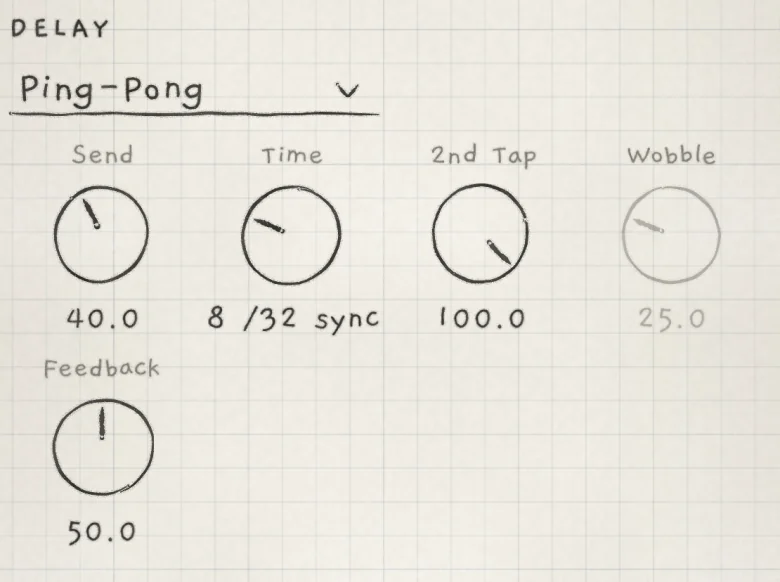 1234
- 1Type menu
- 2Time
- 32nd Tap
- 4Wobble, greyed
Ping-Pong echoes alternate left and right. Time is the hop to the left and Time × 2nd Tap the hop to the right; at 2nd Tap 100.0 the hops are equal, and lower values give an uneven, swung bounce.
Feedback counts per round trip, one hop left and one right. The repeats always decay; at 100.0 they fade slowly over many round trips.
The send enters mostly one side, and that side changes with every hop, so a note starts left or right depending on when it is played. The opposite side carries a quieter copy of each echo, so the repeats keep a centre.
Each repeat is band-limited, so the repeats thin and darken as they recirculate. Nothing saturates. Changes of Time glide, as in Classic.
- Load Init. In DELAY, choose Octave.
- Set Send to 50.0 and Feedback to 60.0.
- Turn Time left of centre to 8 /32 sync.
- Play a short note. The first echo sounds an octave up, each further repeat another octave up.