CHAPTER 16 OF 54 · SHAPE THE SOUND
Oscillators
The OSC section is where a sound starts. It chooses the generator, the sound source of every voice, and holds the controls that shape its tone, drive it into the voice's low-pass gate, and set each note's pitch and glide. OSC is the first section of the Sound tab, under the engine strip that holds the engine's level, Mute and Solo (Mixer and All page); on the Granular sampler the sample sections, SAMPLER and SAMPLER JITTER, come before it.
#Voice signal flow
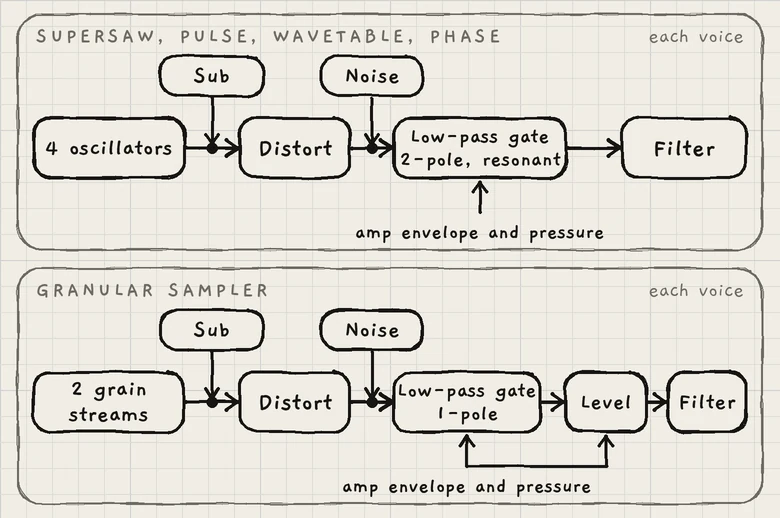 12345678
- 1Generator
- 2Sub
- 3Distort
- 4Noise
- 5Low-pass gate
- 6Filter
- 7One-pole gate
- 8Level stage
Each voice runs its stages in this order:
- Generator. Four oscillators per voice, two per stereo channel, on Supersaw, Pulse, Wavetable and Phase. Two grain streams on the Granular sampler.
- Sub. A sub oscillator, added only in the voice that plays the engine's lowest held note (Sub oscillator).
- Distort. The gain into the low-pass gate.
- Noise. White noise, added after Distort.
- Low-pass gate. One stage for level and brightness, driven by the amp envelope, which follows the note's pressure.
- Filter. The SEM-style multimode filter (Filter).
The voice's level is set at the gate, before the Filter. The 8 voices then sum into the engine's chain (The three engines).
#Generator
 12
- 1Current generator
- 2Generator box
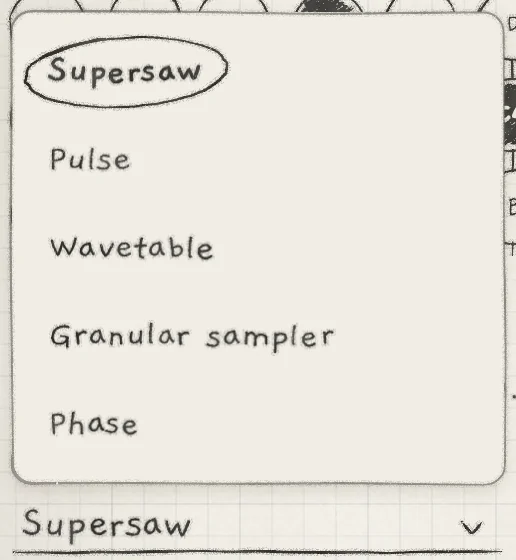
Choose the generator in the generator box at the top of OSC. On the Granular sampler the box heads SAMPLER instead. The generator is saved with the sound.
- Supersaw: four detuned saw oscillators per voice.
- Pulse: a pulse oscillator with variable width.
- Wavetable: scans a set of single-cycle waves, a factory bank or a table you import (Wavetables).
- Granular sampler: plays the samples of the sound's kit as grains (Granular sampler).
- Phase: phase distortion in the style of the Casio CZ. Its own PHASE section follows OSC (Phase).
The small controls A and B beside the box are Macro A and Macro B, which each move several parameters at once (Macros and dice).
#OSC controls
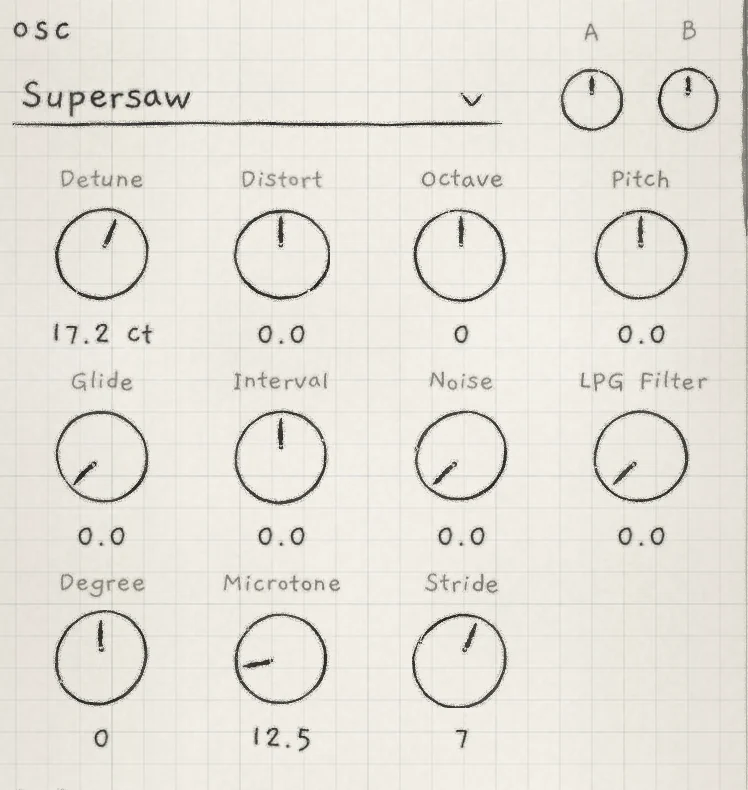 1234567891011
- 1Generator
- 2Macro A and B
- 3Detune
- 4Distort
- 5Octave
- 6Pitch
- 7Glide
- 8Interval
- 9Noise
- 10LPG Filter
- 11Degree, Microtone, Stride
- Detune,Width,Position,WaveThe generator's main tone control, named for what it does on each generator. Detune 0.0 to 50.0 ct, Width 50.0% to 3.0%, Position 1.0 to 8.0, Wave one of 8 waves. Init: 17.2 ct (Supersaw). None on the Granular sampler. CC 13.
- DistortGain into the low-pass gate; above 0.0 it drives the engine's saturation. Bipolar, −100.0 to +100.0. Init: 0.0. CC 4.
- OctaveTransposes the sound in octaves. −3 to +3, stepped. Init: 0.
- PitchTunes every note of the sound; the key stays. −12.0 to +12.0 st. Init: 0.0. CC 9.
- GlidePortamento time. 0.0 to 100.0. Init: 0.0. CC 5.
- IntervalTransposes one stereo channel of each voice. −12.0 to +12.0 st. Init: 0.0. CC 14.
- NoiseWhite-noise level. 0.0 to 100.0. Init: 0.0. CC 2.
- LPG FilterResonance of the low-pass gate. 0.0 to 100.0. Init: 0.0. Not on the Granular sampler. CC 71.
- Degree,StrideShift the Grid's notes along the scale, and set the interval between its columns. See Play the Grid.
- MicrotoneHow far a note bends as the finger moves off a pad's centre. See Play the Grid.
In the Matrix, the tone control, Distort, Noise and LPG Filter have rows in the OSC group; the tone control's row carries its name on the current generator. Octave, Pitch, Interval and Glide are in the PITCH group. Octave's row is stepped.
A dice roll clears every Matrix cell, then writes cells on the tone control, Distort and LPG Filter rows, never on Octave, Pitch, Glide, Interval or Noise (Macros and dice).
Every OSC value is saved with the sound. On the Chords and Strings keyboards, Degree and Stride are greyed.
#Tone control
 123
- 1Width
- 2Position
- 3Wave
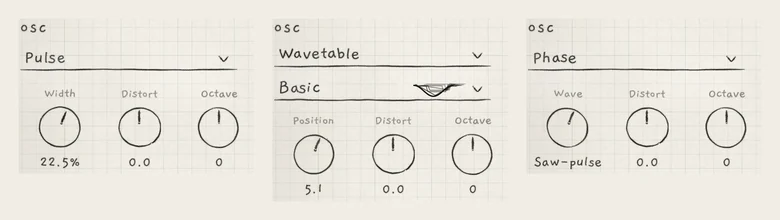
The first control in OSC, the tone control, is one stored value that each generator reads in its own unit. Changing the generator keeps the value: the Init sound's 17.2 ct on Supersaw reads 22.5% on Pulse and 5.1 on Wavetable.
On Wavetable the control is Position, the point in the table (Wavetables); on Phase it is Wave, the CZ waveform (Phase). The Granular sampler has no tone control. Its Matrix row reads Shape there and has no effect.
#Supersaw
Each voice plays four saw oscillators, two per stereo channel. Detune sets how far the outer pair sits from the note, 0.0 to 50.0 ct; the inner pair sits at a third of that. Init: 17.2 ct.
The two channels use mirrored layouts, so the stack is wide in stereo, and the voice's average pitch stays on the note. Detune is finer at small settings. Prs → Detune, +30 widens the stack as pressure rises.
#Pulse
 12
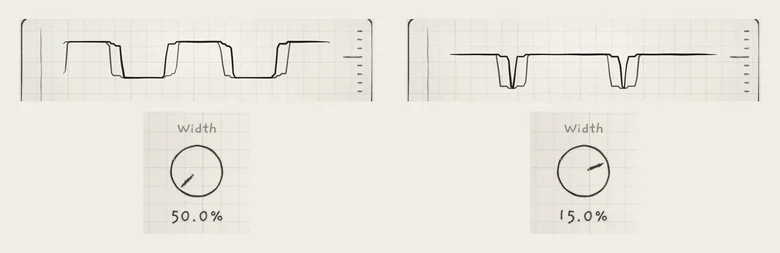
- 1Width 50.0%
- 2Width 15.0%
Width sets the duty cycle, from 50.0% (square) to 3.0%. The range stops short of 0%, so the pulse never thins to silence. On the Init sound it reads 22.5%.
Modulate Width with an LFO for pulse-width modulation (PWM), for example LFO X → Width, +20.
#Distort and Noise
Distort is the voice's gain into the low-pass gate, on an exponential scale. It is bipolar, centred at 0.0.
- Above 0.0 it raises the voice level. The engine's saturation after the voice sum turns the extra level into distortion. It also raises the Noise level.
- Below 0.0 it lowers the voice level. At −100.0, base value plus modulation, the voice is silent.
- The Sub passes through Distort. Raising LPG Filter lowers the gain to offset the resonance.
Noise adds white noise to each voice after Distort and before the gate, so the amp envelope shapes it with the note.
#Pitch, Octave and Interval
Pitch tunes every note of the sound. At 7.0 every note sounds a fifth higher; the key and the note names on the keyboards stay. Root sets the key (Keyboard, key and scale). Pitch is continuous, and modulating it never moves the key.
Octave transposes the sound and is saved with it. The Octave arrows beside Hold are a different control: they move the octave the keyboard plays in (Octave).
Interval transposes one stereo channel of each voice. On the oscillator generators that is two of the four oscillators; on the Granular sampler, one of the two grain streams. The other channel keeps the note.
At 7.0 each voice plays the note and its fifth, one in each channel. Interval is continuous: values between whole semitones detune the pair. The Sub does not follow Interval.
#Glide
Glide sets how long a voice takes to reach a new pitch, 0.0 to 100.0.
Glide acts on every pitch change of a voice: a slide to another pad, a new note on a voice that last played another pitch, and MIDI, arp and pattern notes. On the Grid each column has its own voice, so a new note glides from the last pitch played on that column.
- On Keys, Glide acts on jumps only (Play Keys).
- On Chords, a held change moves each voice to its new note at the Glide time (Play Chords).
- On Strings, a pluck starts at its note without glide (Play Strings).
- On the Granular sampler, a pitched sample glides in pitch; at 0.0 it jumps.
The Sub follows its voice's pitch, so it glides too.
#Low-pass gate
Every voice has a low-pass gate: a low-pass filter whose cutoff follows the amp envelope's level. One stage sets level and brightness together, so a note grows darker as it fades. The design comes from Plinky. On the oscillator generators the gate is the voice's only level stage.
The amp envelope follows the note's pressure, scaled by Sensitivity (Amp envelope). A firmer press opens the gate further.
- Oscillator generators: a 2-pole resonant low-pass. LPG Filter sets its resonance, 0.0 to 100.0, Init 0.0. The resonant peak moves with the envelope.
- Granular sampler: a 1-pole low-pass without resonance, followed by a level stage driven by the same envelope. LPG Filter is hidden.
The gate is separate from the FILTER section, which has its own Cutoff and Resonance (Filter).
- Load Init from the Library and choose Pulse.
- Set LPG Filter to 70.0.
- In ENVELOPE, set Sustain to 0.0.
- Play soft and firm notes. Firm notes open the gate further: louder, brighter and with a higher resonant peak, which falls as the note decays.