CHAPTER 22 OF 54 · SHAPE THE SOUND
Chorus and phaser
CHORUS / PHASER is an insert on each engine that adds movement and width to everything the engine plays: a Chorus or a Phaser, chosen per sound. The section is on the Sound tab, the same on every generator. At Mix 0% the insert is bypassed.
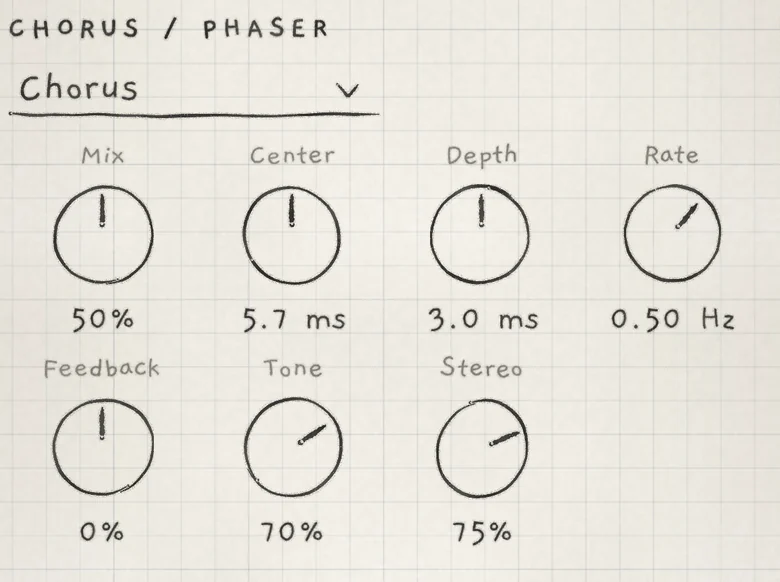 12345678
- 1Type menu
- 2Mix
- 3Center
- 4Depth
- 5Rate
- 6Feedback
- 7Tone
- 8Stereo
#Type
The menu at the top of the section chooses Chorus or Phaser. The two types share one set of stored values and read them in their own units, so a setting changes meaning when you switch type. On the Phaser, Center is labelled Sweep, on the knob and in the Matrix.
The type is saved with the sound. It has no Matrix row, so no modulation, macro or dice roll changes it.
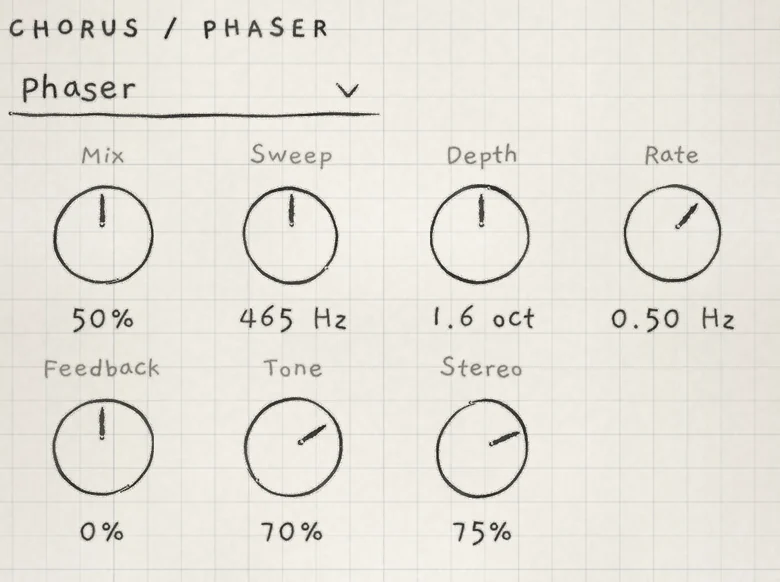 123
- 1Type menu
- 2Sweep
- 3Depth
#Controls
- MixLevel of the effect added to the dry signal; 0% bypasses the insert. 0 to 100%. Init: 0%.
- CenterChorus: base delay time of both delay lines. 2.0 to 16.0 ms. Init: 5.7 ms.
- SweepPhaser: centre frequency of the notch sweep. 120 to 1800 Hz. Init: 465 Hz.
- DepthWidth of the sweep, peak to peak. Chorus 0.0 to 6.0 ms, Phaser 0.0 to 3.2 oct. Init: 3.0 ms, 1.6 oct.
- RateSpeed of the effect's own LFO, free-running, not synced to tempo. 0.02 to 3.00 Hz. Init: 0.50 Hz.
- FeedbackEffect signal fed back to the input, bipolar; raises resonant peaks. Chorus −35% to +35%, Phaser −85% to +85%. Init: 0%.
- ToneColour of the effect signal. Chorus: low-pass from 2.2 to 12 kHz. Phaser: darker below 50%, thinner above. 0 to 100%. Init: 70%.
- StereoDifference between the left and right effect signals. 0 to 100%. Init: 75%.
On both types the sweep drifts slightly at random, so the movement never repeats exactly.
Every control except the type is a Matrix row in the CHORUS / PHASER group, under its knob's name. The insert works on the whole engine, so these rows read the highest Env 2 and the highest pressure among the engine's voices (Modulation matrix). The dice never writes these rows; a roll clears their cells as it clears every other, so it cannot switch the effect on (Macros and dice). Every value is saved with the sound.
The controls have no MIDI CC. To play one from a controller, give it a cell in the A or B column of the Matrix and send CC 1 or CC 30 (MIDI implementation).
#Mix and bypass
The dry signal stays at full level and Mix adds the effect on top. On the Chorus, 100% adds the effect at the same level as the dry. On the Phaser, Mix sets how deep the notches cut; they reach full depth at 100%. On both types the engine is about 1 dB louder at 100% than with the insert bypassed.
When Mix, base value plus modulation, is 0%, the insert is bypassed: the signal passes unchanged and the effect does not run.
Both types leave the bass dry. Below about 120 Hz the signal passes untouched, so a bass fundamental keeps its pitch and level at any setting. Only the band above is chorused or phased.
#Chorus
The Chorus follows the Roland Juno-60's: two delay lines swept in opposite directions by one LFO, each band-limited by Tone like a bucket-brigade (BBD) line. Each line takes its own side of the engine, so the stereo width of the voices is kept.
Depth has less room at the extremes. At fast Rate it stops where the detune reaches about 30 cents; turning it further changes nothing. At short Center it is reduced so the delay never reaches zero.
Stereo sets how much of each line stays on its own side. At 0% both lines play on both sides. Above about 77% the other side's line comes in inverted, as on the Roland Dimension D, for a wider image. The mono sum does not change with Stereo.
#Phaser
The Phaser has eight stages and four notches, in the line of the Mu-Tron Bi-Phase and the Moogerfooger MF-103. Its sweep rises a little faster than it falls, as on the MXR Phase 90.
Tone is neutral at 50%. Below 50% it darkens the effect signal; above 50% it thins it. Tone also filters the feedback, so higher settings give brighter resonant peaks.
Stereo moves the right side's sweep from in step with the left at 0% to opposite at 100%. In mono, Stereo only softens the notches.
The feedback loop saturates softly, so louder notes drive the resonance harder.
#Feedback polarity
Negative Feedback inverts the polarity of the feedback loop. On the Chorus, the comb's resonant peaks move to where its notches were. On the Phaser, the notches and the peaks between them move to a different set of frequencies; the notches keep their full depth.
#Signal position
The insert acts on the engine's summed voices after the saturation and High Pass, and before Synth Lvl, Stereo Width, the engine's Level and the delay and reverb sends. The delay and the reverb receive the chorused or phased signal. The full chain is in The three engines.
- Load Init. In CHORUS / PHASER, choose Phaser and leave Mix at 0%.
- Set Feedback to about +60%.
- On the Matrix tab, set Prs → Mix to +100 in the CHORUS / PHASER group.
- Play the Grid. Pressure sets the phaser's Mix; with several notes, the most strongly pressed voice sets it for the whole engine. With no pressure, the insert is bypassed.