CHAPTER 33 OF 54 · PERFORM AND RECORD
Arp
The arp plays the notes an engine holds one at a time, in a set order, on the engine's tempo. It is set up on the Arp tab.
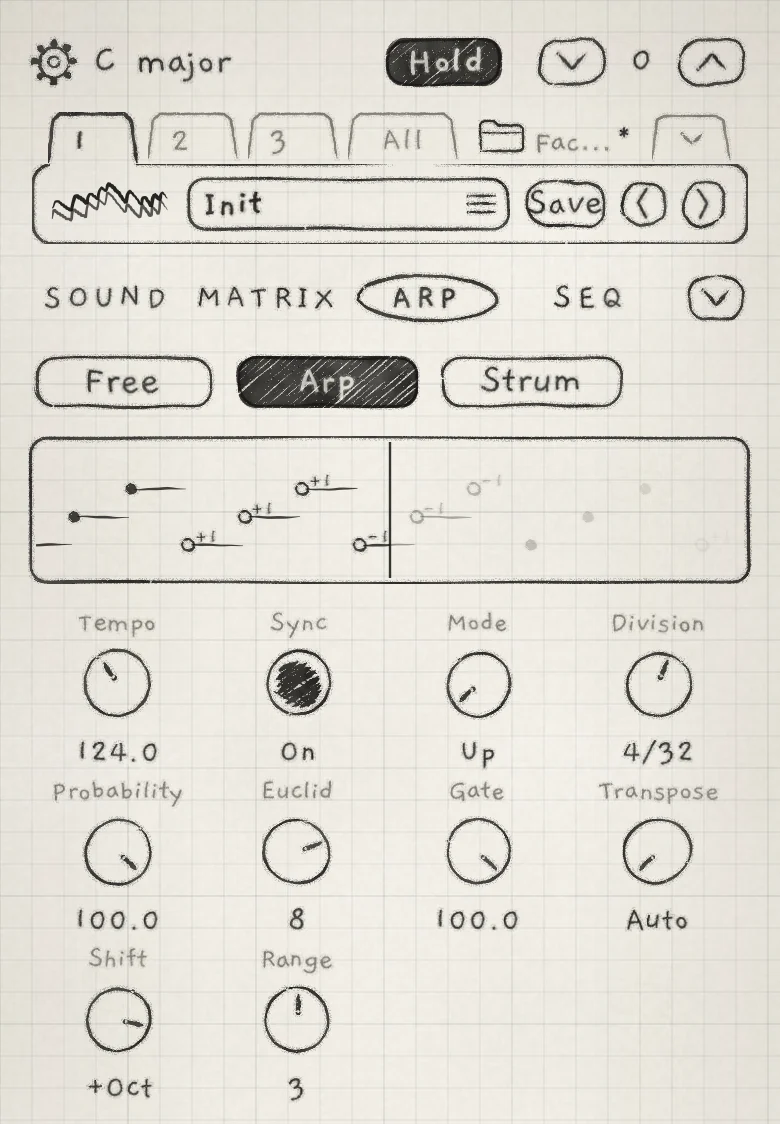 1234567
- 1Free / Arp / Strum
- 2Trace
- 3Mode
- 4Division
- 5Transpose
- 6Shift
- 7Range
The Free / Arp / Strum switch at the top turns the arp on. The strip under it, the trace, draws each note as the arp plays it. The parameters set what it plays:
- Tempo,SyncThe engine's tempo, and whether it follows the master clock. See Arp rhythm and tempo.
- ModeThe order the held notes play in.
- DivisionThe length of one step, synced or free.
- Probability,EuclidWhich steps play: by chance, or as a Euclidean rhythm. See Arp rhythm and tempo.
- GateHow much of each step a note sounds. See Arp rhythm and tempo.
- TransposeThe order of the passes: Auto, up, down, both ways or random.
- ShiftThe interval between passes: a third, fourth, fifth or octave, up or down.
- RangeHow many passes the figure makes before it starts again, each moved by Shift.
#Free, Arp and Strum
The switch sets how the engine plays its notes. It is the same switch as engine sheet › PLAY.
- FreeNotes sound while they are held. The arp is off.
- ArpThe held notes play one at a time, in Mode's order, one per Division step.
- StrumNotes struck together play once, one after another in Mode's order, and ring on. See Strum.
The arp plays every note the engine holds: notes under a finger, notes latched with Hold (Play the Grid), notes held on a MIDI controller and the notes a playing pattern holds. With the arp on, only the arp's notes go to MIDI out, never the notes held under it (MIDI out). CC 102 switches the arp on and off.
On a Strings engine neither the arp nor Strum plays, and engine sheet › PLAY is greyed.
The switch never marks the sound edited, but Save stores it with the sound. A sound saved on Arp or Strum has its own arp: it plays its own switch and arp settings whenever it is chosen. Any other sound plays your own arp settings (Arp rhythm and tempo).
#Start, reset and retrigger
The arp starts its figure from the beginning whenever a step passes with no note held: the next note starts Mode's order and the passes again.
With the transport stopped and Hold off, the first note you play starts a phrase. On a synced Division the first step falls on the next 32nd note of the clock; on a free Division it plays at once. While the transport runs, the steps stay on its grid.
Each step strikes its note again with a new attack of the amp envelope; the held notes off the step are silent. Each arp note sounds at the current pressure of its held note.
#The trace
The trace draws the notes the arp plays: what it played on the left, what it will play next on the right.

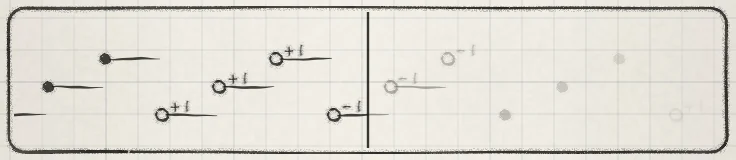 12345
- 1A note: dot and gate line
- 2One pass up (+1)
- 3One pass down (−1)
- 4Now
- 5The guess
On the Grid each lane is one column, column 1 at the bottom; height shows the column, not the pitch. On Keys and Chords a lane is one of the engine's eight voices. A dot marks a step, and the line after it lasts as long as the note sounds, so Gate shortens it.
A hollow dot is a note moved away from its held note by Range's passes. The number beside it counts passes in Shift's direction: +1 is one Shift interval, +2 two, −1 one interval the other way. With Shift on +Oct the number is octaves.
The vertical line is now. Left of it is the last 1.5 s as played, modulation included. Right of it is a fading guess at the next 1.5 s from the current settings, passes included. The guess stops where the arp rolls dice: the Rnd orders, Transpose on Random or Unique Random, and Probability below 100.0 without a Euclid length.
#Mode
Mode sets the order of the held notes. Init: Up. CC 103. Mode is a Matrix row in the ARP group; modulation steps it from order to order.
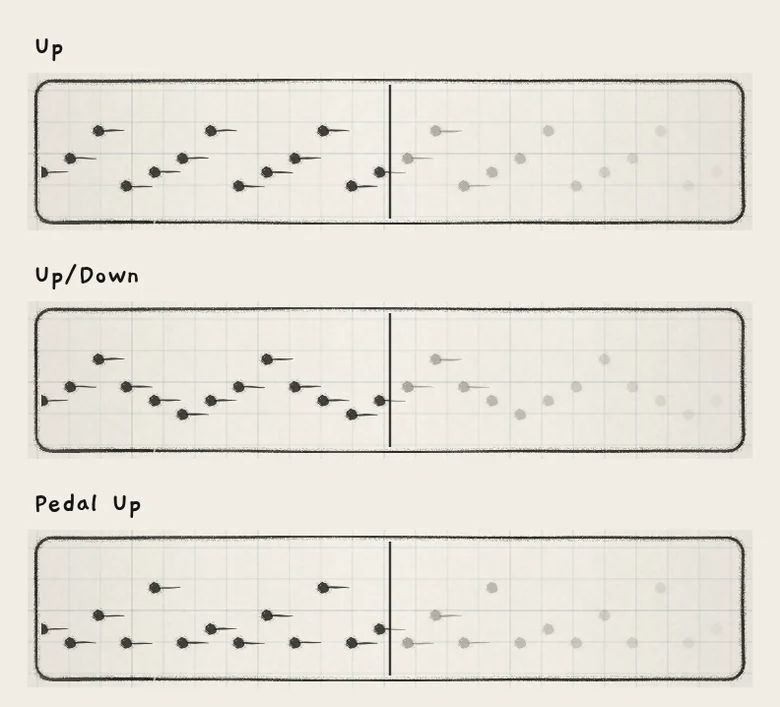
- Up,DownLowest to highest, or highest to lowest, then from the start again.
- Up/DownUp, then down. The top and bottom notes play once at each turn.
- Up/Down RepeatUp, then down. The top and bottom notes play twice at each turn.
- Pedal Up,Pedal Down,Pedal Up/DownThe lowest held note plays on every other step; the other notes play between in Up, Down or Up/Down order.
- RndA random held note each step, never the same note twice in a row.
- 2xRndTwo different random held notes each step.
- Up 8 Steps,Down 8 Steps,Up/Down 8 Steps,Rnd 8 Steps,2xRnd 8 StepsThe same orders over the engine's eight voices, on the Grid its eight columns. A voice with no held note is a silent step. Up/Down 8 Steps turns like Up/Down Repeat.
Every order takes the held notes by pitch, low to high, whatever order you played them in. With Transpose on Auto and Range above 1, the Rnd orders also pick a random pass each step.
An older INK sound, or one imported from a Plinky (Where INK comes from), that is stored on Plinky's Chord order plays 2xRnd or Up 8 Steps, whichever its stored value is nearer. The knob shows the order that plays.
On Strum, Mode offers only the orders that strike each note once (Strum).
#8 Steps
The 8 Steps orders walk all eight of the engine's voices, held or not, so the gaps become rests. On the Grid each column has its own voice: Up 8 Steps runs over columns 1 to 8, left to right, and an empty column is a silent step. The notes still follow pitch: the first held step plays the lowest held note, the next held step the next note up.
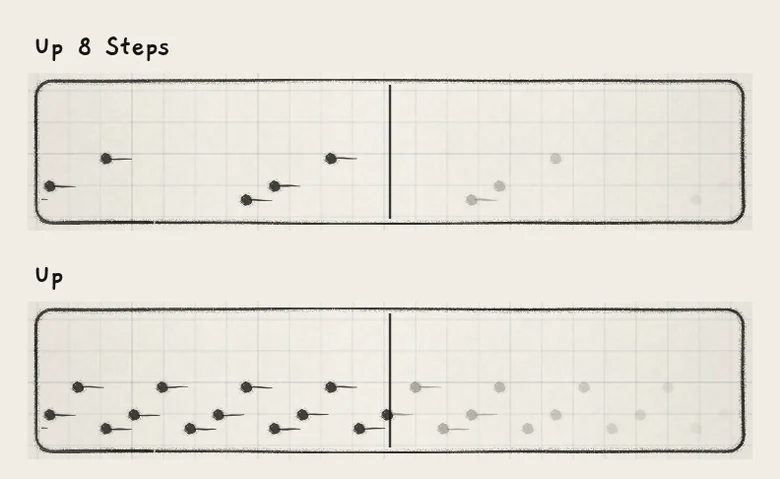 123
- 1Column 1
- 2Column 3: no note, a silent step
- 3Columns 5 to 8: silent steps
On Keys and Chords a held note takes a free voice, which has no fixed place on screen, so the rests fall where no held note took a voice.
#Division
Division sets the step length. Init: 3/32. CC 104.
The knob has two halves. Right of centre it is synced to the engine's tempo, in 32nd notes, from 1/32 at the centre to 256/32 at the right end: 1, 2, 3, 4, 5, 6, 8, 10, 12, 16, 20, 24, 32, 40, 48, 64, 80, 96, 128, 160, 192 or 256. Larger is slower:
| Division | Step |
|---|---|
| 2/32 | 16th note |
| 3/32 | dotted 16th (Init) |
| 4/32 | 8th note |
| 6/32 | dotted 8th |
| 8/32 | quarter note |
| 32/32 | one bar |
| 256/32 | eight bars |
Left of centre it is free and ignores tempo: from 0.0 next to the centre to 100.0 at the left end, about 3.8 to 24 steps a second. The Delay's Time knob is the mirror image: free on the right, synced on the left (Delays).
A Matrix cell on Division moves it only within the half the knob is on, so modulation never switches between free and synced.
#Range, Transpose and Shift
Range repeats Mode's run over the held notes as passes, each moved by an interval in the key. Transpose sets the order of the passes, Shift the interval between them. Use them to climb a figure through octaves, or to stack it in fifths or thirds without playing more notes.
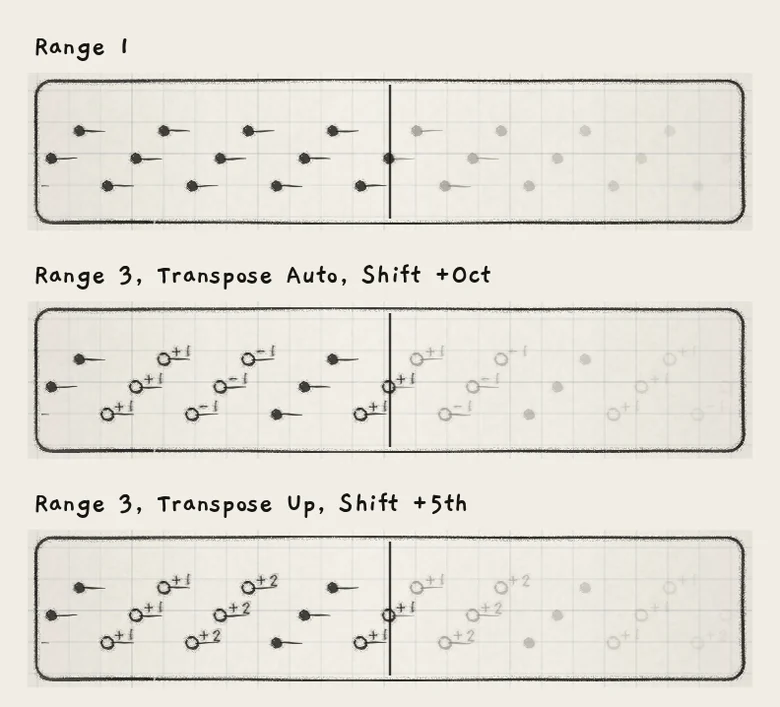
- RangeNumber of passes. 1 to 4. Init: 1. CC 107.
- TransposeOrder of the passes. Auto, Up, Down, Up/Down, Down/Up, Random, Unique Random. Init: Auto. No CC.
- ShiftInterval between passes, in the engine's key. −Oct, −5th, −4th, −3rd, +3rd, +4th, +5th, +Oct. Init: +Oct. No CC.
Range at 1 plays the held notes only. A pass is one run of Mode over the held notes.
Transpose on Auto is Plinky's own octave walk. The passes sit around the held notes (Range 2: 0 and +1; Range 3: −1 to +1; Range 4: −1 to +2), and the arp moves to the next one each time Mode's run comes round.
The other orders start at the held notes and move in Shift's direction. Up plays passes 0, 1, 2 and on; Down the reverse. Up/Down and Down/Up bounce without repeating the end passes. Random picks a pass at random; Unique Random never picks the same pass twice in a row.
Shift on −Oct or +Oct moves each pass by 12 st. The 3rd, 4th and 5th settings move by scale steps of the engine's key, so the notes stay in key: 2, 3 and 4 steps in a seven-note scale, 1, 2 and 3 in a pentatonic scale. A negative Shift moves the passes down.
Range and Shift are Matrix rows in the ARP group; Shift is read on each step. Transpose has no Matrix row. On Strum all three are greyed, since a strum plays each note once.
- Tap Hold, play three notes in one row of the Grid, then open the Arp tab and tap Arp.
- Set Division to 2/32 and Range to 3.
- Set Transpose to Up and Shift to +5th.
- Set Mode to Up 8 Steps. The three passes climb in fifths of the key, with the empty columns as rests.