CHAPTER 25 OF 54 · SHAPE THE SOUND
Multiband
MULTIBAND is a three-band compressor and EQ on each engine's finished sound. Raise a band to compress it and make it denser and louder; lower it to cut it.
It acts after Main Wet/Dry (Reverb and mix), on the dry signal and the delay and reverb returns together. The engine then leaves INK on the bus set in engine sheet › AUDIO OUT, Main or Multibus (INK in a host). On the Sound tab its section sits between REVERB and MIX; in the chain it comes after both (The three engines).
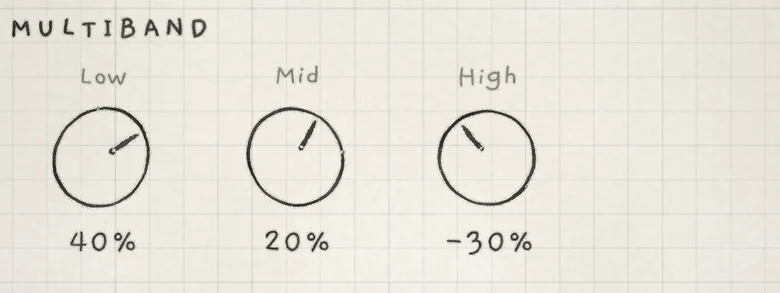
- LowCompresses and raises, or cuts, the band below 250 Hz. −100% to +100%. Init: 0%.
- MidThe same for the band from 250 Hz to 1.5 kHz. −100% to +100%. Init: 0%.
- HighThe same for the band above 1.5 kHz. −100% to +100%. Init: 0%.
Each Multiband amount is bipolar. Above 0% the band is compressed and given make-up gain; below 0% it is cut; at 0% it is untouched.
Low, Mid and High are rows of the MULTIBAND group in the Matrix and are saved with the sound. Modulation can carry an amount across 0%, from compression into a cut. The controls have no MIDI CC. To play one from a controller, give it a cell in the A or B column of the Matrix and send CC 1 or CC 30 (MIDI implementation). The dice never writes these rows; a roll clears their cells as it clears every other (Macros and dice).
#Positive amounts
A positive amount compresses the band, then adds a fixed make-up gain. Only the louder moments, well above the band's own average level, are pulled down; the make-up then lifts the whole band. The band comes out denser and louder, with its peaks rising less than its average.
At +100% the make-up is +7.5 dB on Low, +7.6 dB on Mid and +8.1 dB on High. The amount scales make-up and compression together: +50% gives half of each.
Each band is compared with its own average level, which follows the sound and holds through tails, pauses and silence. A note after a pause is compressed like the same note in a phrase. The attack lets the start of each note through; it is slowest on Low and fastest on High.
Compression only pulls loud moments down. Quiet material and tails are never compressed and rise by the make-up gain alone.
#Negative amounts
A negative amount is a fixed cut, with no compression: −6 dB at −50%, −12 dB at −100%. With negative amounts MULTIBAND works as a broad three-band EQ on the engine's output.
#Bands and crossovers
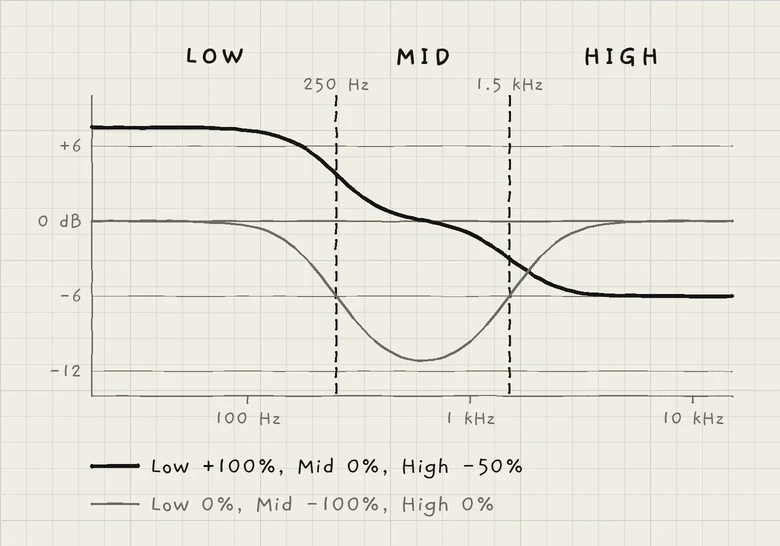
The crossovers are at 250 Hz and 1.5 kHz. The bands blend into each other across each crossover, with no steep edge: a full Mid cut is −6 dB at each crossover and about −11 dB at the centre of the band.
At 0% a band is untouched. With all three at 0%, the engine's sound passes unchanged, only delayed (Latency).
#Latency
MULTIBAND looks 2 ms ahead, so it delays the engine's audio by 2.048 ms at every setting, 0% included. In a host, INK reports this delay as latency, together with its sample-rate conversion, and the host compensates for it (INK in a host). MIDI out leaves with the same delay, so it stays in line with the sound (MIDI out).